
By Culbreath | Grant Writing & Nonprofit Strategy | Series: The Grant-Ready Nonprofit
I remember the first time I sat down to write a grant proposal. I had the funder’s guidelines open on one screen, a blank document on the other, and absolute confidence that I knew what I was doing. I had read articles. I had watched webinars. I had even reviewed a few sample proposals online.
Within twenty minutes, I was stuck on the very first field in the application portal: the organization’s legal name. Sounds simple, right? Except the name on the client’s letterhead was different from the name on their IRS determination letter, which was different again from what was registered with the state. Three variations of the same organization, and I could not figure out which one to use.
That moment taught me something I now tell every nonprofit leader and every aspiring grant writer I work with: before you write a single word of a grant proposal, you have to understand the legal and organizational foundation the whole thing sits on. The writing is the easy part. The infrastructure is where proposals live or die.
So let me walk you through what I wish someone had told me at the beginning — starting with the most fundamental question in the nonprofit grant world.
What Is a 501(c)(3) and Why Does It Unlock Funding?
The term gets thrown around constantly in nonprofit circles, but it is worth understanding precisely. A 501(c)(3) is an organization that the IRS has formally recognized as tax-exempt under Section 501(c)(3) of the Internal Revenue Code. In plain language: the IRS has reviewed the organization, confirmed it exists to serve a charitable, educational, religious, or scientific purpose, and agreed that it does not owe federal income tax on income related to that purpose.
Here is why this matters practically for grant writing: the vast majority of foundations, government agencies, and corporate giving programs can only legally award grants to 501(c)(3) organizations. Without that status, you are locked out of most funding before you even start. When I secured HUD grants and NIH funding for wellness clients, the 501(c)(3) determination letter was the first document every funder wanted to see — before the narrative, before the budget, before anything.
The determination letter is the single most important document a nonprofit owns for grant purposes. Protect it, scan it, and keep copies in multiple locations. You will attach it to grants more times than you can count.
Public Charity vs Private Foundation: The Distinction
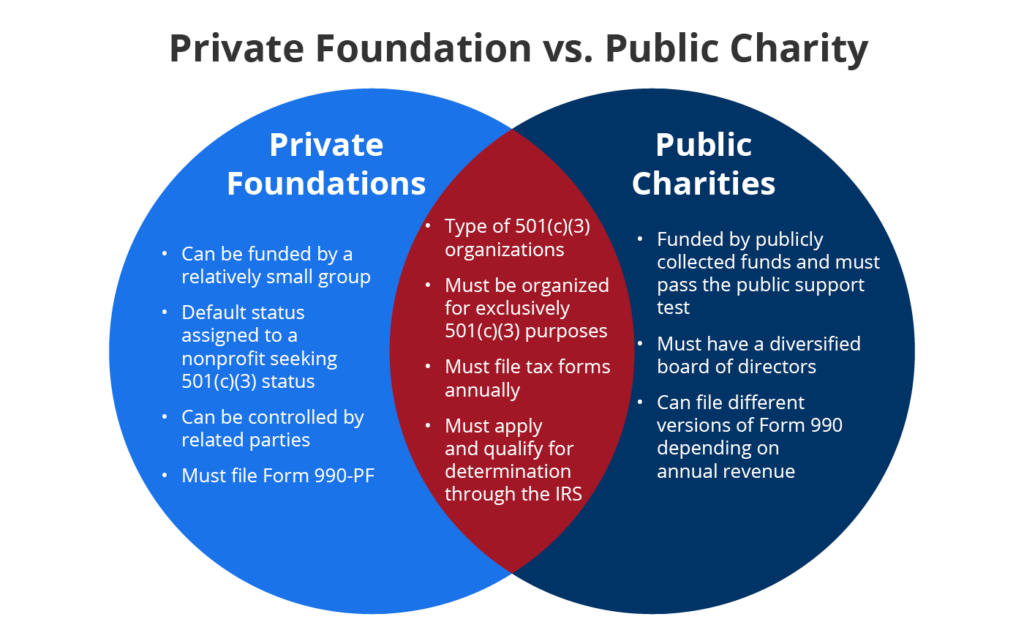
This is the distinction I see misunderstood most often, even by experienced nonprofit professionals. There are two types of 501(c)(3) organizations: public charities and private foundations. And understanding the difference is not just academic — it determines who you are writing for and who you are writing to.
A public charity draws its support from a wide range of sources — government grants, foundation grants, individual donors, corporate contributions, and program service revenue (the fees it earns by delivering its mission-related services). That breadth of public support is precisely what qualifies it as a public charity in the eyes of the IRS. The public is investing in it, so the organization is accountable to the public.
A private foundation, on the other hand, is typically funded by a single narrow source — one family, one individual, or one corporation. The Gates Foundation, the Ford Foundation, the MacArthur Foundation — these are private foundations. They are funded by concentrated private wealth, governed by stricter IRS rules including a mandatory 5% annual distribution requirement, and they primarily exist to give money away.
Here is the practical implication for your grant writing career: private foundations write the checks. Public charities cash them. When you are doing prospect research for a nonprofit client, almost every foundation you find in Candid or Foundation Directory Online is a private foundation — and they are your targets, not your competitors.
One more thing about transparency: both types of organizations file public disclosure documents with the IRS. Public charities file the Form 990. Private foundations file the Form 990-PF. Both are publicly searchable on Candid and ProPublica’s Nonprofit Explorer. The 990-PF is particularly valuable for grant researchers — it lists every grant the foundation made that year, to whom, how much, and for what purpose. I pull 990-PFs constantly when doing funder research for clients. It tells me more about a foundation’s real priorities than their website ever will.
The First Thing I Check With Every New Client
Before I write a single sentence for any nonprofit client, I run what I call a compliance check. I ask for seven specific documents and I will not start writing until I have reviewed them all.
The IRS 501(c)(3) determination letter — confirming tax-exempt status and showing the exact legal name as the IRS recognizes it.
The EIN — the 9-digit federal tax identification number, formatted as XX-XXXXXXX. This appears in the very first field of almost every grant portal ever built.
The state Certificate of Incorporation — confirming the organization legally exists as a corporation in its state.
Current bylaws — not the bylaws from 2009 that nobody has looked at since. Current, board-approved bylaws.
The most recent Form 990 — which I review carefully for financial health, governance policies, and executive compensation before submitting any proposal.
State charitable registration — confirming the organization is registered to solicit donations in relevant states.
Audited financial statements — required for most larger grants, typically those above $100,000.
If any of these documents are missing, outdated, or inconsistent with each other — for example, the legal name on the determination letter does not match the bank account — I flag it before writing anything. No amount of brilliant proposal writing overcomes a legally deficient organization.
What This Means For You
Whether you are a nonprofit leader preparing to seek funding, or a freelance grant writer building your practice, the lesson is the same: the legal and administrative foundation of a nonprofit is not background noise. It is an active component of every competitive grant application.
Funders conduct due diligence. They check IRS tax-exempt status. They review 990s. They look at board composition. They verify governance documents. The strongest proposals I have ever written succeeded not just because of compelling narratives, but because the organizations behind them were legally sound, financially transparent, and governmentally compliant before I started typing.
In the next post in this series, I want to go deeper into the governance layer — the board of directors, the bylaws, and the policies that determine whether a funder trusts your organization with their money. Because getting the legal structure right is only the first step.
Culbreath is a freelance grant writer and nonprofit strategy consultant with a track record spanning HUD, NIH, and competitive federal and foundation funding. This post is part of the series: The Grant-Ready Nonprofit.